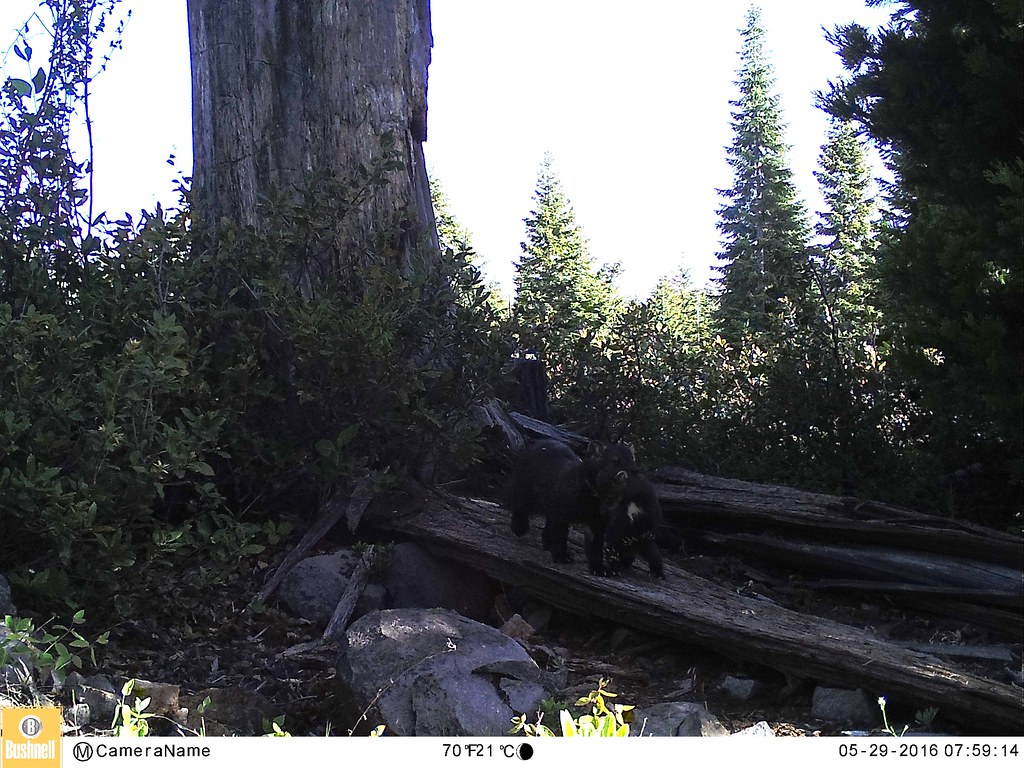
On the morning of April 22, a remote camera mounted on a hemlock trunk at 5,640 feet above the Carbon River triggered fourteen times in forty seconds. The animal in the frames was unmistakable: low to the ground, heavily built, dark brown with two pale stripes running from shoulder to rump. A wolverine, Gulo gulo, the first photographed in Mount Rainier National Park since 1916.
The camera belonged to the Cascades Wolverine Project, a small monitoring effort run by a coalition of state, federal, and nonprofit researchers since 2017. The image was reviewed three days later by a project biologist named Cara Sundstrom, who had spent the previous winter convinced that the wolverine had finally crossed the I-90 corridor.
Sundstrom is thirty-six and lives in Ashford, Washington, a small town six miles outside the southwest entrance to Rainier. She drove up to the Carbon River station on the morning of April 27 to collect the camera's SD card in person.
She watched the sequence three times on her laptop in the truck. Then she called her project lead from the parking lot.
Wolverines were extirpated from Washington's Cascades by the early twentieth century, the casualty of trapping, predator control programs, and the species' naturally low density. They began to return through British Columbia in the 1990s, working their way down the spine of the range slowly.
By 2010 there were confirmed reproducing animals in the North Cascades. By 2018 a single male had been detected on Mt. Adams. The crossing of the I-90 corridor, sixty miles wide of human development, was the long-suspected and long-feared barrier.
What the Rainier image confirmed, Sundstrom said, was not a population. It was an individual, in all likelihood a dispersing young male, and one image is not a colonization event.
It was, however, the first photographic evidence that the southern Cascades had been re-entered.
The follow-up work began immediately. Over the next three weeks, the crew expanded the camera array on the north side of the park from twelve stations to twenty-eight. Each station consists of a baited tree, a hair-snare brush, and a motion-triggered camera. The bait is typically deer or elk carcass, tied at a height that forces a wolverine to climb and stretch, exposing belly markings for individual identification.
The work is unglamorous. A station check involves a long approach on skis or snowshoes, often through brushy second-growth, often in weather that the rest of the park's visitors avoid by definition. Sundstrom's longest single approach during the April expansion was a nine-mile round trip on telemark gear to a site above the Mowich Lake road, which had not yet melted out for the season.
She found four wolverine images at two separate stations by the end of May. The chest markings, faintly visible on the best frame, suggested two different individuals, both probably young males.
The presence of females will be the question that determines whether this is a colonization or a transit. Female wolverines need stable snowpack into late spring for denning. They give birth in February and March in snow tunnels that may extend two meters underground, and they do not produce kits in good condition without that thermal cover.
Climate models for the southern Cascades project a continuing reduction in late-spring snow at the elevations wolverines prefer. The wolverine's return to Rainier, Sundstrom said, is happening at the leading edge of a habitat that is itself contracting.
"I've been waiting for this since I started in 2014," she said. "And now it's happening, and the thing I cannot tell you is whether it is the beginning of a recovery or a very photogenic stutter."
The park has, for now, not announced the detections publicly. The Cascades Wolverine Project's preference is to keep specific camera locations quiet, both to limit disturbance and to deter the small number of wildlife photographers who would attempt to find the animals themselves.
The park's superintendent was informed on April 30. The U.S. Fish and Wildlife Service was notified the same day. The wolverine was federally listed as threatened in November 2023, which gives the agency a regulatory interest in any newly documented populations.
On the evening of May 14, Sundstrom drove down to the Nisqually entrance to meet a colleague from Cascadia Wildlands. They sat in the truck with the laptop open and watched the original April 22 sequence again. The animal stayed in the frame for thirty-eight seconds. It investigated the bait, climbed the tree, descended, paused, and trotted out of frame down a faint game trail toward the river.
It did not look hurried. It looked, more than anything, like an animal that had been moving through this country for some time, and was passing through one particular hemlock stand on the way to somewhere else.
Sundstrom closed the laptop and watched the dusk come down over the Nisqually valley. The mountain was hidden in cloud, as it usually is in May.
"What I'd like," she said, "is for someone in 2046 to look at this image and not think it was a miracle. I would like it to be the first frame in a long sequence."