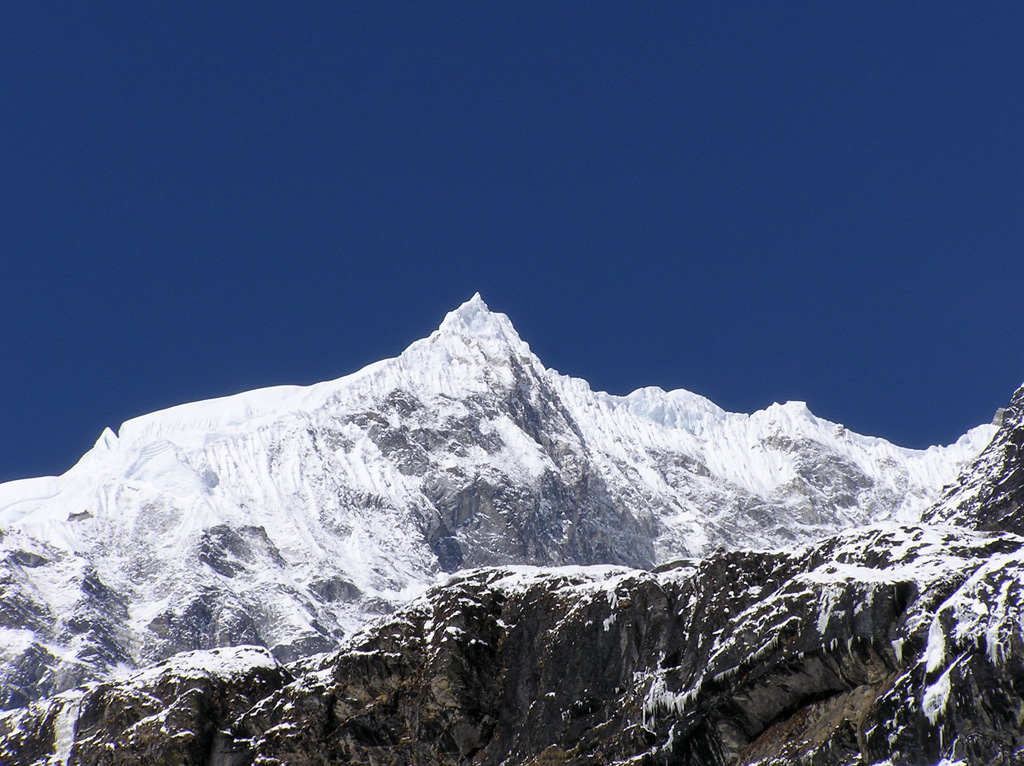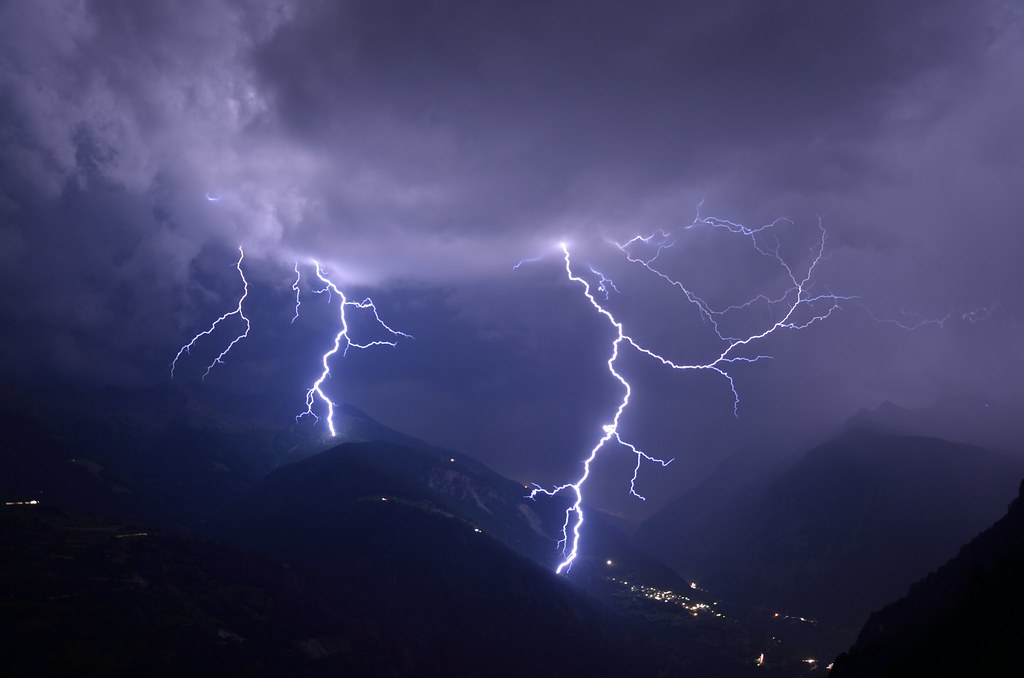
On the afternoon of July 16, 2025, on the Schaufelspitze in the Stubai Alps, a party of two was struck by lightning while descending the south ridge at 3,180 metres. Both survived. One was knocked unconscious for approximately ninety seconds and sustained burns along the path of a metal helmet strap. The other was thrown two metres downslope and walked, with assistance, to the Dresdner Hütte that evening.
The Austrian Alpine Club's incident report, published in November, listed the strike time as 14:47 and the first thunder of the afternoon, audible from the summit, as 13:35. The seventy-two minutes between those times is the subject of this article.
Lightning is the most studied of the alpine hazards and, in some ways, the least intuitive. The folklore around it is largely wrong. The mitigations that work are unglamorous. The mitigations that feel protective often are not.
Some facts that are worth knowing.
Lightning does not usually strike the highest point in the landscape. It strikes the most conductive point within a roughly cone-shaped volume below the cloud base. On a ridge, that point is often a person, an ice axe, a fence post, or a small metal sign. The ridge itself, being rock, is a less attractive target than the warm, salty, conductive person standing on it.
A direct strike is uncommon. Ground current, in which a strike lands nearby and current spreads outward through the ground, is much more common and accounts for the majority of lightning injuries in the mountains. A walker standing with feet together on the same patch of ground has a small voltage differential between their feet. A walker standing with feet apart, or lying down, has a much larger one.
Side flash is the third mechanism: a strike hits an object, such as a tree or a rock outcrop, and a portion of the current jumps to a nearby person. This is why standing close to a tall isolated tree or against a cliff face is worse than standing in the open at the same elevation.
Most lightning injuries are not burns. They are cardiac and neurological. The current passes through the body, disrupts the heart's electrical rhythm, and the casualty's heart either restarts on its own or does not. CPR begun promptly on a lightning casualty has an unusually high success rate compared with cardiac arrest from other causes, because the heart muscle is often otherwise healthy.
These facts suggest a small set of practices.
Get off the ridge. The single most effective mitigation is to descend, before the storm arrives, to terrain that is not the highest local point. A col, a couloir, a gully, a treeline, the floor of a bowl: all of these are better than the ridge above them. The descent should begin when the first cumulonimbus is visible building within ten kilometres, not when the first thunder is audible.
Use the thirty-thirty rule, then improve on it. The thirty-thirty rule, taught in many wilderness medicine courses, states that any walker who can count fewer than thirty seconds between a flash and its thunder should be in a shelter, and that the wait after the last thunder before resuming exposed travel should be at least thirty minutes. Both numbers are conservative starting points. On an alpine ridge, both should be doubled. Lightning has been recorded striking up to fifteen kilometres from the parent cloud.
Separate the party. If descent is not possible and a storm has arrived, the party should spread out at intervals of at least fifteen metres, so a single ground-current event does not affect everyone. Each person should crouch low on an insulating pad if one is available, with feet together, hands off the ground, and metal objects, including helmets with metal hardware, placed several metres away.
Avoid the false shelters. Shallow caves and overhangs concentrate side flash. Standing under an isolated tall tree, especially on a ridge, is among the worst available choices. A bivouac shelter against a cliff face on a ridge is dangerous. A deep cave, well back from the entrance, with no contact with the walls, is safe; shallow caves are not.
Wet rope is not insulation. A rope team caught on a ridge in a storm cannot rely on the rope or on rock-climbing hardware to provide protection. The rope should be coiled away from the body, anchors should not be touched, and the team should separate to ground-current intervals if they can.
There is a piece of folk wisdom that one should remove metal objects before a storm. The current research suggests this is largely irrelevant. The conductivity of a human body dwarfs the conductivity of a watch or a belt buckle. A walker who is struck will be injured along the path the current takes through their body, and metal jewellery is unlikely to be that path. The energy is too large for the metal to matter much.
What does matter is the location of metal objects relative to the body during a strike. An ice axe held vertically on a ridge is functioning as a small lightning rod and should be put down. A trekking pole strapped to a pack is fine. A helmet with a metal head strap, in contact with the scalp, can produce burns if a strike or side flash passes through it; this is the mechanism that injured one of the Schaufelspitze walkers.
The most useful planning tool is the convective forecast. In the Alps, the ZAMG produces a daily thunderstorm outlook that is accurate enough to plan against. In the western United States, the Storm Prediction Center's convective outlooks serve the same purpose. A walker who consults these forecasts the evening before, and adjusts the start time to summit before the typical afternoon convective initiation, has done most of the work that lightning risk requires.
The simplest rule, on most summer days in most temperate mountain ranges, is to be off the high terrain by noon. This is not always possible. When it is not, the ridge becomes a place to leave quickly, not a place to wait out a storm.
The two walkers on the Schaufelspitze were experienced. They had checked the forecast. The forecast had called for isolated thunderstorms after fifteen hundred. They had aimed to be off the ridge by then. They were behind schedule by roughly forty minutes when the first thunder reached them. The forty minutes was the difference.
The lesson, repeated in alpine incident reports year after year, is that the schedule is a part of the weather plan. A walker who keeps to the schedule keeps to the weather window. A walker who lets the schedule slip by an hour has, in effect, chosen a different weather forecast than the one they read at the hut the night before.
Tomas Lendvai writes from Innsbruck. He has been on three ridges during thunderstorms in his career and intends not to be on a fourth.