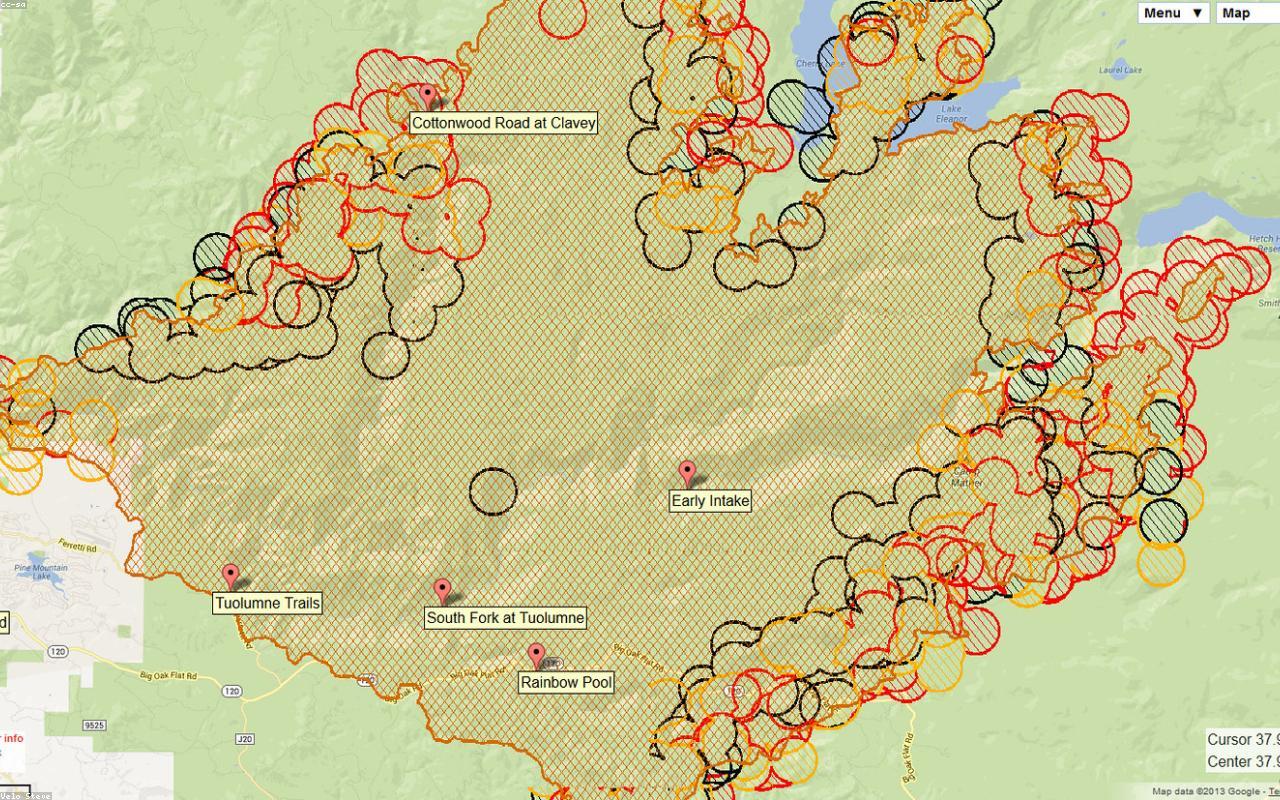
On the evening of August 14, 2024, at an Incident Command Post set up in the parking lot of a closed elementary school in Three Rivers, California, a Forest Service GIS specialist named Aurelia Tonnemacher printed the day's perimeter map of the Cypress Fire on a wide-format plotter. The map was thirty-six inches wide. It was up to date as of 1800 hours. Tonnemacher pinned it to a foam board and stepped back. By the time the operations briefing began at 2000 hours, the perimeter had moved at least three hundred metres in two locations. The map was already wrong.
Tonnemacher knows this. Everyone in the room at the briefing knows this. The map is read with the understanding that it is provisional, that the line drawn on it is the best information available as of the timestamp in the corner, and that the actual fire is somewhere else.
Wildfire perimeter maps are, in the United States, produced through a workflow that has been refined over thirty years and remains imperfect. The perimeter on the map is drawn from a combination of sources: infrared imagery captured by aircraft flying at night, aerial reconnaissance during the day, GPS tracks recorded by hand crews and engines on the ground, observations from lookouts and fire weather stations, and satellite imagery when available. The cartographer's job is to reconcile these sources into a single defensible line.
Reconciling them is harder than it sounds. The infrared imagery, which is the most authoritative source for what the fire was doing at the moment of capture, is captured once or twice per night by aircraft from the National Infrared Operations program. Each capture takes between two and six hours to process and deliver. By the time the imagery reaches the GIS specialist, the fire has continued to move.
The aerial reconnaissance is more current but less precise. A spotter in a helicopter or small fixed-wing aircraft can see the fire's edge in daylight and can describe its position to a dispatcher, but the description is imprecise compared to the infrared line. The GPS tracks from ground crews are precise but local; they describe only the segments of perimeter the crews have walked.
Tonnemacher reconciles these by laying them as separate layers in a GIS project, examining the discrepancies, and drawing a perimeter that uses the most authoritative source available for each segment of the line. Where infrared imagery is recent, she uses infrared. Where ground GPS tracks are recent, she uses ground GPS. Where neither is available and aerial reconnaissance is the only source, she draws a line and labels it as estimated.
The resulting map carries a label in the lower right corner indicating the time of the last update for each source and a note that the perimeter is estimated. Briefing officers read the label aloud at the start of every operational briefing. The label is not a disclaimer in the legal sense. It is an honest description of what the map is.
The cartography itself is constrained. There is a national standard for wildfire perimeter maps, maintained by the National Wildfire Coordinating Group, that specifies symbology, colour, scale conventions, and required information. The perimeter is shown as a red line of standard weight. Areas inside the perimeter are shaded in a light orange. Areas where the fire is no longer active but has burned are shown in a darker brown. Fire camps, drop points, helibases, and division boundaries are marked with standardised symbols.
The standardisation matters because the maps are read by people who rotate in and out of incidents and need to read the maps quickly. A perimeter map of the Cypress Fire is legible, without explanation, to a strike-team leader who arrived from Oregon the previous day and to a logistics officer who has worked twenty fires in ten states.
What the standardisation does not specify is the cartographic judgement that goes into drawing the perimeter line itself. Tonnemacher described several recurring decisions she has to make on every map.
The first is how to handle a perimeter that is genuinely uncertain. Where the infrared imagery shows a heat signature that may or may not be active fire, where ground crews have not been able to confirm, and where aerial reconnaissance has not had a clear view, Tonnemacher must decide whether to draw the line at the inner edge of the uncertain zone, at the outer edge, or somewhere in between. The choice has operational consequences. A line drawn too close in will lead operations to plan around a perimeter that may not hold. A line drawn too far out will lead operations to expend resources on ground that is not in fact threatened.
Her default, she said, is to draw the line at the outer edge of the uncertain zone and to label the segment as estimated. This errs on the side of caution from a safety perspective. It also produces maps that, in retrospect, sometimes show a perimeter larger than the fire actually was. She accepts the trade-off.
The second recurring decision is how to handle interior heat. A fire that has burned through an area is not necessarily out. There may be unburned islands, smouldering stumps, or heat sources that could reignite under the right wind. The infrared imagery shows these. The map convention is to show them as small interior polygons. The cartographer decides which interior heat signatures are worth marking and which are too minor to clutter the map.
Tonnemacher's rule for the Cypress Fire was to mark any interior heat signature larger than half an acre. Below that threshold, she did not include the polygon, on the principle that the map would become unreadable. Operations officers can request more detail for specific areas if they need it.
The third decision is the projection. Wildfire maps in the United States are produced in a regional projection, usually a UTM zone or a state plane coordinate system, depending on the location of the fire. Choosing the projection is mostly mechanical, but for fires that cross zone boundaries the cartographer must make a choice that will affect how the map is read by GPS-equipped crews. Tonnemacher's standard for the Cypress Fire was UTM zone 11 north, NAD83 datum, which matched the GPS units used by most ground crews.
The maps are reissued, on a typical incident, twice per twenty-four-hour operational period: once in the morning before the day shift's briefing, and once in the evening before the night shift's briefing. The morning map incorporates the previous night's infrared run. The evening map incorporates the day's ground reports and any updated reconnaissance. Both are dated and time-stamped. Older maps are kept in a binder at the planning section's table for reference.
The Cypress Fire ran from August 12 to October 3, 2024, and ultimately burned 41,816 acres in the Sequoia National Forest. Tonnemacher worked on the incident from August 13 through August 27, when she rotated home for required rest. She produced, by her count, twenty-eight perimeter maps in fifteen days. She estimates that perhaps six of them were materially correct as of the time of issuance. The rest were close enough to be useful and labelled honestly enough that no one mistook them for the ground.
The maps are archived. The Forest Service keeps every perimeter map produced for every incident, with the underlying GIS data, in a national repository. They are used afterwards for post-incident analysis, for legal and insurance purposes, and for historical research on fire behaviour. The maps that were superseded in the field are part of the official record. They are not corrected after the fact.
Tonnemacher said this matters. The historical record of wildfire perimeters, including the wrong ones, is the record of what the fire managers knew when they made their decisions. Rewriting the maps later to match what was eventually discovered would falsify the decision-making history. It would make the past look more knowable than it was.
She still has the binder of perimeter maps from the Cypress Fire in her office in Porterville. There are forty-one maps in the binder, including the ones she produced and the ones produced by the cartographers who relieved her. The binder is heavy. She showed it to a visitor in April, opened it at random to August 17, and pointed at a segment of perimeter that, by the time of the evening briefing, was known to be wrong by half a mile.
The map was right about a great deal. The roads, the section lines, the topography, the structures, the locations of the camps and helibases, the divisions and the assignments — these were all accurate. The fire's edge was an honest estimate, drawn carefully, and wrong. That, she said, is what the maps are. They are an honest estimate. They are not the fire.