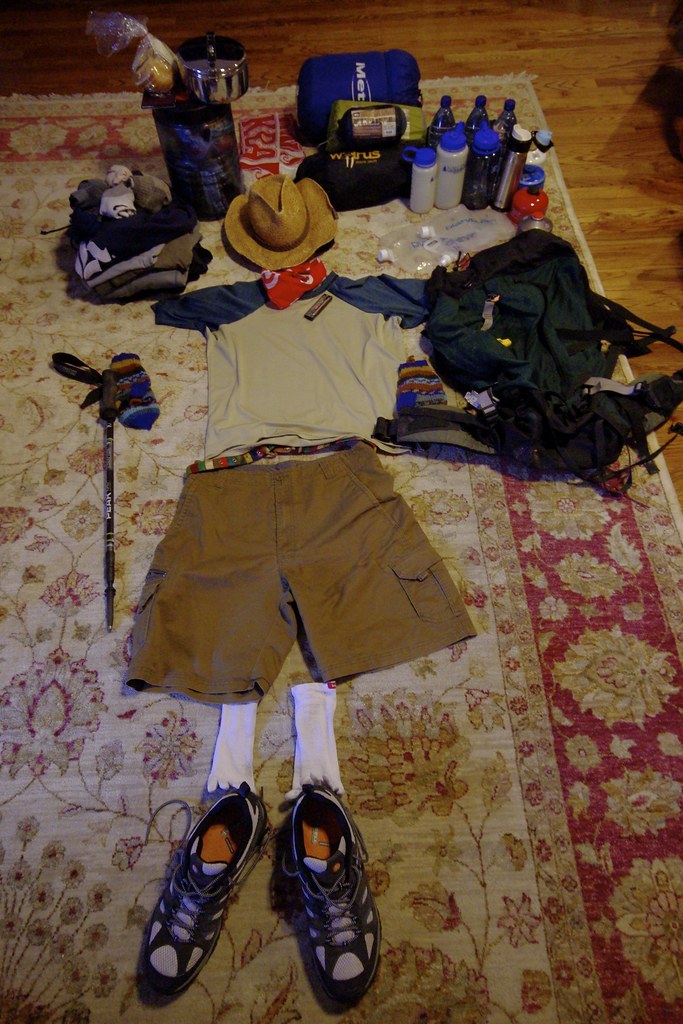
Margaret Holcomb left the trailhead at Lincoln Gap in central Vermont on the morning of May 6th carrying a thirty-litre pack with three days of food, three nights of sleeping kit, and one full change of clothes.
The pack weighed thirteen pounds and four ounces with water. She weighed it on the porch scale at the Lincoln Inn the night before.
She has been backpacking for thirty-one years and editing a quarterly magazine about it for the last one. She is not an ultralight purist. She thinks the discipline has become a culture and the culture has begun to drift away from the discipline.
But she packs light, and she packs the same way for most three- and four-day trips between April and June.
The pack itself is a small frameless climbing-style daypack with a hipbelt and a side-water-bottle sleeve. It cost her ninety-six dollars in 2018 and has done about four hundred trail nights. She is on the second set of shoulder strap foam.
The shelter is a tarp. Not a pyramid, not a dyneema fortress, just a flat rectangular tarp of eight-by-ten silnylon, pitched as a lean-to with two trekking poles when she can find good trees and as a low A-frame when she cannot. With a bivy bag underneath, it is dry through anything short of a sustained gale, and her experience is that sustained gales in Vermont in May are rare enough to plan around rather than for.
Tarp, lines, six titanium stakes: total weight twenty-two ounces.
The sleeping system is a thirty-degree down quilt, a three-quarter length closed-cell foam pad, and a bivy. The bivy adds maybe seven ounces and ten degrees of effective warmth. The closed-cell pad is heavier than her summer inflatable but does not puncture and can be sat on at lunch.
Quilt, pad, bivy: forty-six ounces.
Clothing is where most shoulder-season packs go wrong. Holcomb's rule is one set of hiking clothes worn, one set of sleeping clothes carried, and one insulating layer that can be worn over either.
Hiking clothes: synthetic shorts over a long polyester running tight, a long-sleeve sun shirt, a wool cap, sun gloves. Sleeping clothes: a dry long-sleeve merino top and a dry pair of fleece-lined tights. Insulation: a hooded synthetic puffy, the cheap kind, eleven ounces.
She does not carry rain pants in May in Vermont. She carries a rain jacket, the lightest one she owns that has reasonably tight cuffs and a decent hood. Six ounces.
The kitchen is austere. A small canister stove that screws directly onto the canister, a 700-millilitre titanium pot, a long-handled titanium spoon, a small bic lighter, a backup mini-bic in a different pocket.
She does not cook complicated food on the trail. Oats for breakfast with powdered milk and brown sugar. Cold lunches of crackers, hard cheese, and dry sausage. Hot dinner is a single freezer-bag meal she has assembled at home — rice and lentils and dehydrated vegetables, sometimes a curry powder, sometimes a tomato base.
Three days of food: thirty-three ounces, planned at about eleven ounces a day. She is not trying to set a record. She is trying to eat enough to walk well.
Water she filters with a small inline squeeze filter that fits onto a one-litre soft flask. She carries two flasks, one in the side pocket, one in a shoulder strap pocket where she can drink without stopping. The filter weighs three ounces.
First aid is small. Ibuprofen, a few blister patches, a tiny tube of antibiotic ointment, two safety pins, a square of duct tape wrapped around the lighter. The serious first-aid skills, she says, are not in the kit. They are in the head.
Navigation: a printed copy of the relevant Long Trail map sections, a small compass clipped to the shoulder strap, a phone with offline maps as backup. Headlamp the size of her thumb, an extra battery in the lid pocket. A small knife the size of her little finger.
What is not in the pack: a stove windscreen, a camp pillow, a book, spare batteries for anything except the headlamp, camp shoes, a chair, deodorant, a separate camp shirt, a second water filter, an emergency blanket, a fork, a cup, a backup pair of socks beyond the dry sleeping pair.
She does not judge people who carry these things. Some of them she carried for years. She found, item by item, that she did not need them, and that the absence of them made the days move more easily.
On the third evening she pitched the tarp above Sucker Brook below the Mount Abraham summit, ate her dinner in the last of the light, and slept eleven hours without moving.
The pack was on her back again at six the next morning. It still weighed about eleven pounds with two days of food gone and a litre of water on board.
A lighter pack is not a virtue. It is a tool. It lets you walk further before you have to stop noticing the walking. That, she will say if pressed, is the only argument for it.