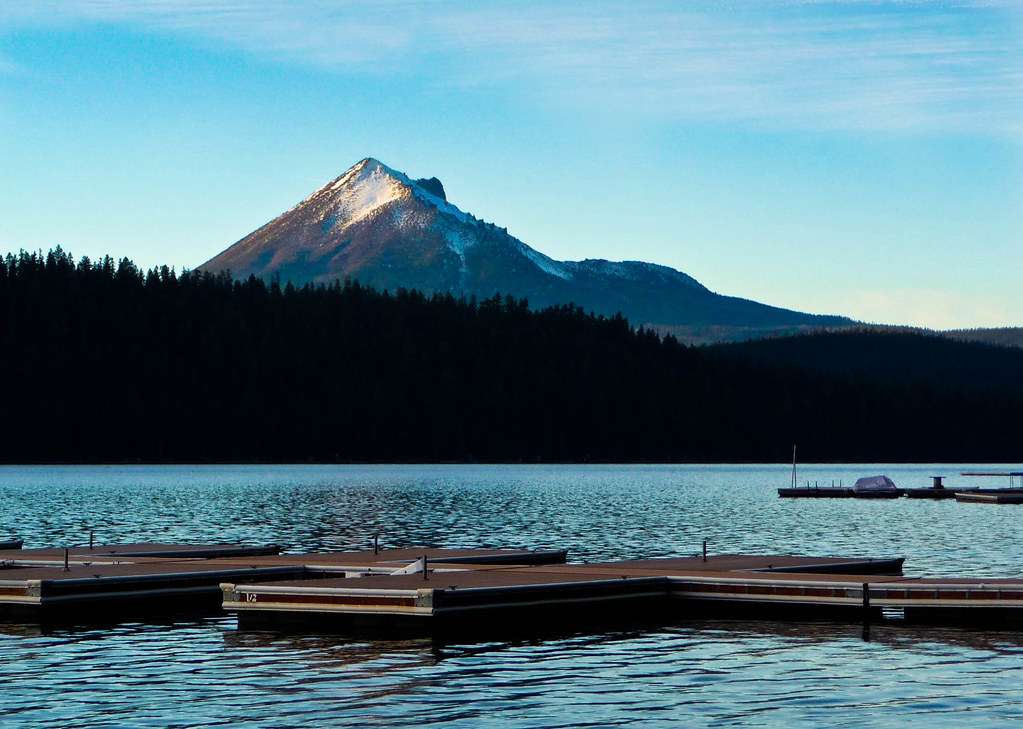
The Desolation Peak lookout sits at 6,050 feet on the eastern edge of North Cascades National Park, three and a half miles up from Ross Lake by way of a switchback trail that climbs through silver fir, then subalpine meadow, then nothing but rock and the wind that comes off the Pickets to the west.
Linnea Vargstad has staffed it for the U.S. Forest Service for six summers. She is forty-one, a former cartographic technician from Mount Vernon, Washington, and she keeps the cabin the way her grandmother kept a kitchen: every utensil hung from a specific nail, every nail labeled in pencil.
The cabin is fourteen feet on a side. There is a single bed under the south window, an Osborne Fire Finder bolted to the center table, a propane two-burner, a radio, a set of USGS quads in a flat file, and three notebooks: one for weather, one for smoke calls, one personal.
The personal notebook is not required. Most lookouts keep one anyway.
On the morning of May 11, the visiting writer signed the guest log at 7:04 a.m. and was handed a clipboard, a pair of Steiner 8x30 binoculars, and a brief on the local fuel moisture, which was eleven percent and falling.
Linnea explained the Osborne the way a piano teacher explains a metronome. The brass ring is the azimuth. The two sighting hairs are the eyes. When you spot a smoke, you sight it through both hairs, read the bearing off the ring, and then a second lookout, ten or sixty miles away, does the same. Two bearings cross on a map. That is where the fire is.
It sounds simple. It is simple. The complication is that you have to look at the entire landscape, all day, in order to notice the one part of it that is changing.
By the second morning the visiting writer had begun to understand the discipline of looking. The eye wants to land on the obvious things — the snowfields on Hozomeen across the lake, the wakes of the supply boats — and it has to be trained, gently, to scan the slopes instead. The slopes where the smoke would be.
At 11:20 a.m. on May 12 a small cumulus formed above Crater Mountain to the southwest. Linnea noted it in the weather book: Cu, 11:20, SW quadrant, light vert. dev. She did not look at it again for forty minutes. When she did, it was a thunderhead.
She marked it again: Cb, 11:58, vigorous, anvil forming. Then she radioed it in.
The thunderhead drifted northeast over the Pasayten Wilderness and produced, between 1:14 and 1:32, eleven cloud-to-ground strikes that she could see. She logged the bearings of each. Two of them looked, from Desolation, as if they might have hit timber.
A strike that hits a green fir in May usually goes nowhere. The cambium is wet. The duff is wet. The strike scorches a stripe down the bark and the fir, more often than not, lives. But a strike that hits a standing dead snag in a drought year can smolder for nine days before it shows.
Linnea has seen this. In 2023 she watched a strike from her window on June 8 and called in the smoke on June 16, eight days later, when a faint blue thread finally rose above the trees of the Lightning Creek drainage. The fire ran to forty acres before it was contained.
On the third morning the visiting writer walked the trail down to the Ross Lake shore for water. The round trip is two and a half hours. Linnea cannot leave the lookout for that long during fire season, so she catches her own water off the cabin roof in a galvanized tank, and rations it.
When the writer returned, Linnea was reading The Maine Woods at the table, the binoculars beside her, her eyes on the window.
Jack Kerouac staffed this lookout in the summer of 1956. He produced from his sixty-three days here the long opening of Desolation Angels, and a great deal of complaint about loneliness. Linnea finds him sentimental. She prefers Gary Snyder, who staffed nearby Crater Mountain a few years earlier and wrote, she says, like a man who actually wanted to be there.
The visiting writer spent the fourth day cleaning the cabin windows. There are fifteen of them, plus the glass of the cupola. They must be clear for the smoke watch to work. Linnea uses vinegar and old newspaper and a wooden ladder she carried up in 2021.
At dusk on the fifth day a herd of seven mountain goats crossed the ridge two hundred yards north of the cabin. Linnea logged them in the personal notebook, not the weather book. She has rules about which book is which.
On the sixth morning a Bell 407 helicopter circled the peak and dropped a resupply: ten gallons of propane, a flat of canned tomatoes, a sack of mail, and one cabbage. The pilot did not land. The supplies came down on a long line. Linnea waved. The pilot waved back. The cabbage survived.
On the last morning, before walking out, the visiting writer asked her what she would do if the fire season was canceled, if the lookout program were finally retired in favor of satellites and cameras, as has been proposed every few years since 1996.
Linnea thought about it for a while. The MODIS satellites can spot a fire of about ten acres, she said, after it has been burning for hours. The cameras on the new towers can see further than she can, in some directions, but they cannot smell the smoke when the wind shifts, and they do not know which snag the lightning hit on May 12.
She said she would miss the work. Then she said the country would miss it more, but probably would not notice.
The walk down took four hours. At the lake the writer turned and looked back at the cabin, a small white square against the rock, and could just make out, with the borrowed binoculars, Linnea at the south window. She was scanning the slopes.