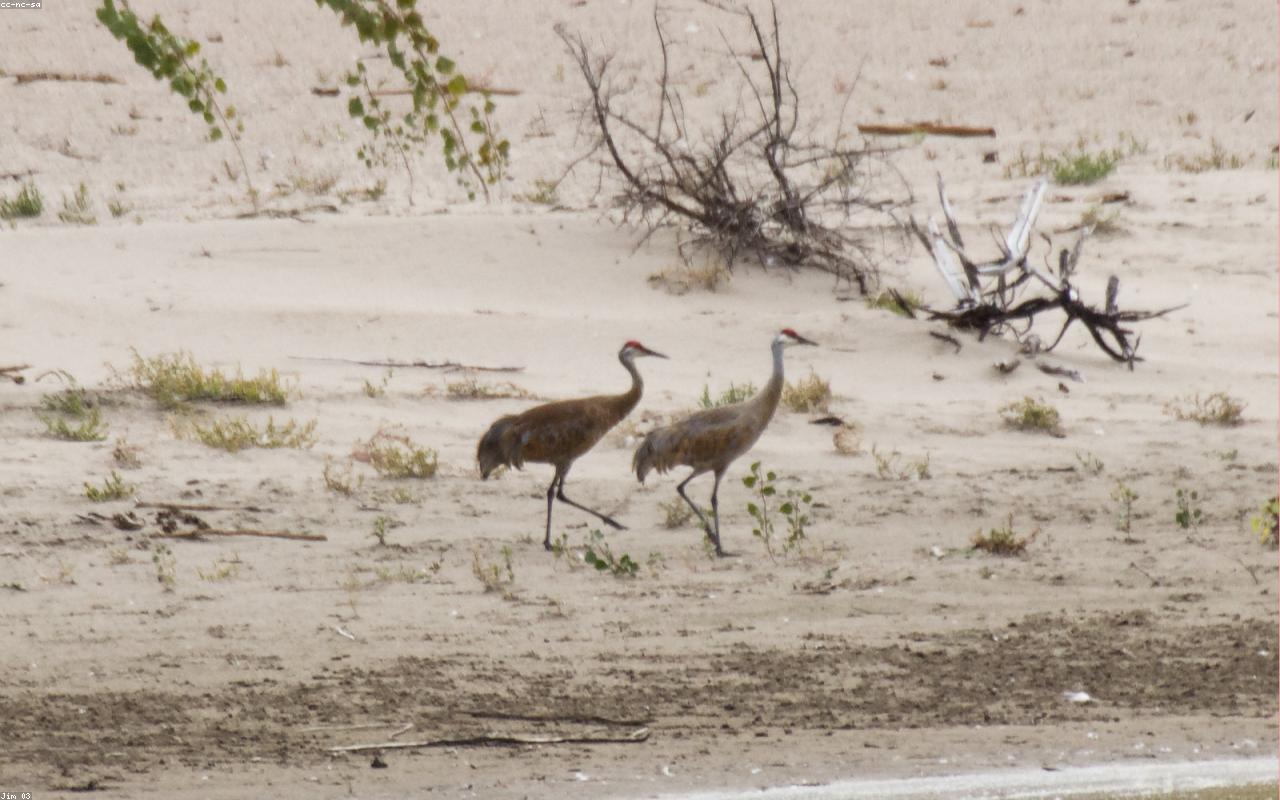
The Platte River runs east across south-central Nebraska in a wide, shallow, braided channel that is, in most years, perhaps a foot deep. The river is famous mostly because for about six weeks each spring, between late February and mid-April, it becomes the night roost for approximately eighty percent of the world's sandhill cranes.
The current estimate, from the spring 2026 aerial survey, is 738,000 birds. They arrive in waves from the south, stage for two to four weeks each, eat the remaining corn from last year's harvested fields by day, and lift off again, in waves, headed for breeding grounds that range from the Yukon to Siberia.
Imogen Reece visited the Rowe Sanctuary at Gibbon, Nebraska from March 24 to March 28, 2026, by invitation of the Audubon staff, to write about the staging from the perspective of a conservation manager. She was not a tourist. She had worked, as a younger ecologist, on a related crane recovery project for the New Zealand Department of Conservation, and she wanted to see the Platte cranes for professional reasons.
She also wanted to see them because she had read about them since she was a child.
She arrived at Rowe at 5:15 a.m. on March 24 in a rental car from the Kearney airport. The temperature was 28 degrees. The sky was clear. There were already eleven other people in the parking lot, all of them carrying spotting scopes and tripods.
The walk to the blind is about a third of a mile, in the dark, on a graveled path. Headlamps are not permitted. The Rowe staff lead the groups in by the faint blue light of a single shielded LED at waist height. They ask for silence beginning at the trailhead.
They are insistent about this. A sudden noise can lift the cranes off the river. A lifted crane wastes the energy reserves it needs for the next leg of its migration. A repeatedly lifted crane has a measurably lower probability of successfully nesting two months later in Alaska or Siberia.
The blind at Rowe is a long, low wooden structure parallel to the river, with rectangular viewing slits at standing height and at sitting height. There is a bench. There is no heat. There is a roof.
Imogen took a seat at the western end of the bench and put her thermos between her boots and her small notebook on her knee. The cranes were on the river in front of the blind, perhaps a hundred and fifty metres out, in numbers she could hear but could not yet see.
The sound of a hundred thousand sandhill cranes in the predawn is not, to use the inevitable word, magical. It is industrial. It is the sound of an enormous wet machine that has not been oiled in a long time and is shifting in its bearings. It is a continuous low rattling chorus over which individual calls rise and fall in the way individual horns rise and fall in city traffic at distance.
She wrote in her notebook: 5:48. still dark. river audible. cannot yet count.
First light came at 6:32 a.m. The river was suddenly visible, and on it, in front of the blind, were perhaps forty thousand cranes standing in water to their ankles in loose ranks running east to west for as far as she could see in either direction.
She tried to estimate. She gave up. She wrote: cannot estimate. perhaps 30k visible from this blind alone. perhaps 80k.
The cranes lifted in waves between 6:55 and 7:35 a.m. They did not all leave at once. They left in groups of a few hundred to a few thousand, each group rising together with the running take-off characteristic of long-legged birds, calling continuously, climbing in spirals, and then peeling off east or west toward the day's feeding fields.
She watched the last of them leave the section of river in front of her blind at 7:41 a.m. The river, suddenly, was empty.
The Rowe staff opened the back door of the blind at 7:45. Most of the visitors filed out. Imogen stayed for another forty minutes, watching the empty river, taking notes.
She did this for five mornings. Each morning the river held cranes. Each morning they lifted, in waves, between roughly 6:55 and 7:35. Each morning the river was suddenly empty. The numbers varied. On her fifth morning, March 28, the staff estimated forty-two thousand birds in the section visible from her blind, the lowest count of her week and a sign that the spring departure was already underway in earnest.
She spent the afternoons in Rowe's small library, reading the staging counts back through 1973, the year the modern survey began. The total at the Platte in 1973 was estimated at 270,000 birds. In 2026 it is 738,000.
The increase is not, mostly, because the cranes are doing better. It is because changes in agriculture and water management have concentrated their staging into a shorter stretch of river, so the birds that have always come are now packed into a smaller area, and easier to count.
She left Nebraska on the evening of March 28. She wrote her piece on the plane home to Christchurch. The piece is in the spring issue. The notebook, with the count estimates and the times and the temperatures and the names of the cranes that she could not, in fact, name individually, is on the shelf above her desk.
She intends to go back in 2027. She has booked a blind already.