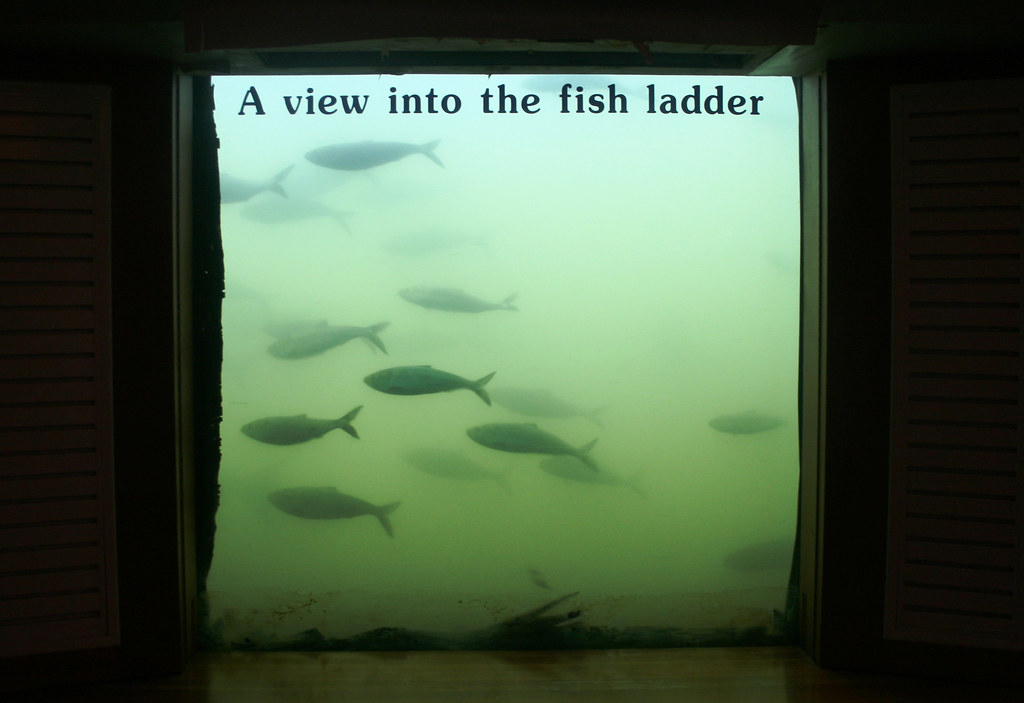
Cory Penobscot Nation biologist Jonas Sapiel arrived at the Milford Dam fish-counting station on April 15, 2026, and switched on the underwater camera that watches the upstream-most opening of the new fish ladder.
Through the day, until he switched it off at sunset, the camera recorded the passage of forty-eight river herring, six American shad, and no Atlantic salmon.
He had not expected salmon. The first of the year's returning adults rarely arrive at Milford before the first week of May, and the run, in recent years, has been small enough that the early days produce zeros.
The dam itself is a low concrete structure on the lower Penobscot River, built in 1906 and rebuilt in the 1980s for hydroelectric generation. It is the second of two remaining mainstem dams on the river, after the removal of Veazie in 2013 and Great Works in 2012.
The original fish ladder was a vertical-slot design with 32 pools rising 8.8 meters from tailrace to forebay. It worked, in the engineering sense, in that fish could ascend it. It worked less well, in the biological sense, in that many fish chose not to.
Studies between 2017 and 2023 by the U.S. Geological Survey's Conte Anadromous Fish Research Laboratory documented passage delays of up to eleven days for tagged salmon at Milford, with a notable fraction of fish never ascending at all and either falling back downstream or dying in the lower river.
The retrofit, designed by an Augusta engineering firm in consultation with the Penobscot Nation and funded by a combination of Brookfield Renewable, NOAA, and the Atlantic Salmon Federation, cost 14.2 million dollars and took fourteen months to complete.
It modified the lower entrance of the ladder, deepened three pools, replaced the vertical-slot baffles in the lower third with a denil arrangement, and added a secondary attraction-flow channel along the river-right wall of the spillway.
The theory behind the changes is that salmon, which navigate primarily by current, find the dominant flow at the dam to be the turbine outflow, which leads them to the wrong side of the structure. The new attraction channel is intended to make the ladder entrance hydraulically more obvious.
Whether it works will be visible in the counter data over the next two seasons. In 2025, before the retrofit was operational, 561 Atlantic salmon were counted at Milford. The historical baseline, before the dams, is estimated to have been between 70,000 and 100,000 fish per year.
Sapiel, who is thirty-four and has worked at the counting station since 2018, said in conversation that he tries not to attach his hopes to single-season numbers. The river, he said, runs longer than any one biologist's career.
The Penobscot Nation has been the lead partner on Atlantic salmon recovery on the river since the early 2000s, in collaboration with state and federal agencies. The Nation's interest is not only ecological. The species is central to Penobscot ceremonial and dietary tradition and was harvested in the river until the early twentieth century.
No subsistence harvest has been permitted since 1948. The Nation's leadership has stated, repeatedly, that a return to harvest is not the near-term goal. The near-term goal is a self-sustaining population.
What that population looks like is debated. The Atlantic Salmon Federation has used a recovery target of 11,000 returning adults to the Penobscot. Some biologists believe this is conservative and others that it is unattainable in a warming North Atlantic.
The dam, in the meantime, will continue to generate electricity. Its hydroelectric license, renewed in 2019, runs to 2049. Removal is not on the table within that period.
The retrofit is therefore not a substitute for removal but the best available alternative to it, given the politics and economics of the licensed structure.
Sapiel's daily logs, which he files to a shared database maintained jointly by the Nation and the Maine Department of Marine Resources, will accumulate through the spring and into the early summer.
By late June, the bulk of the year's salmon run will have either passed Milford or failed to. The number will be made public in a short report in mid-July.
The retrofit's success or failure, in scientific terms, will not be assessable from a single year of data. The biologists involved are planning a five-year evaluation window, with comparison to a baseline assembled from the 2017 to 2023 USGS work.
In the meantime, the camera is running, the herring are moving, and a man in a small concrete shed beside a river in Maine is counting them by hand.