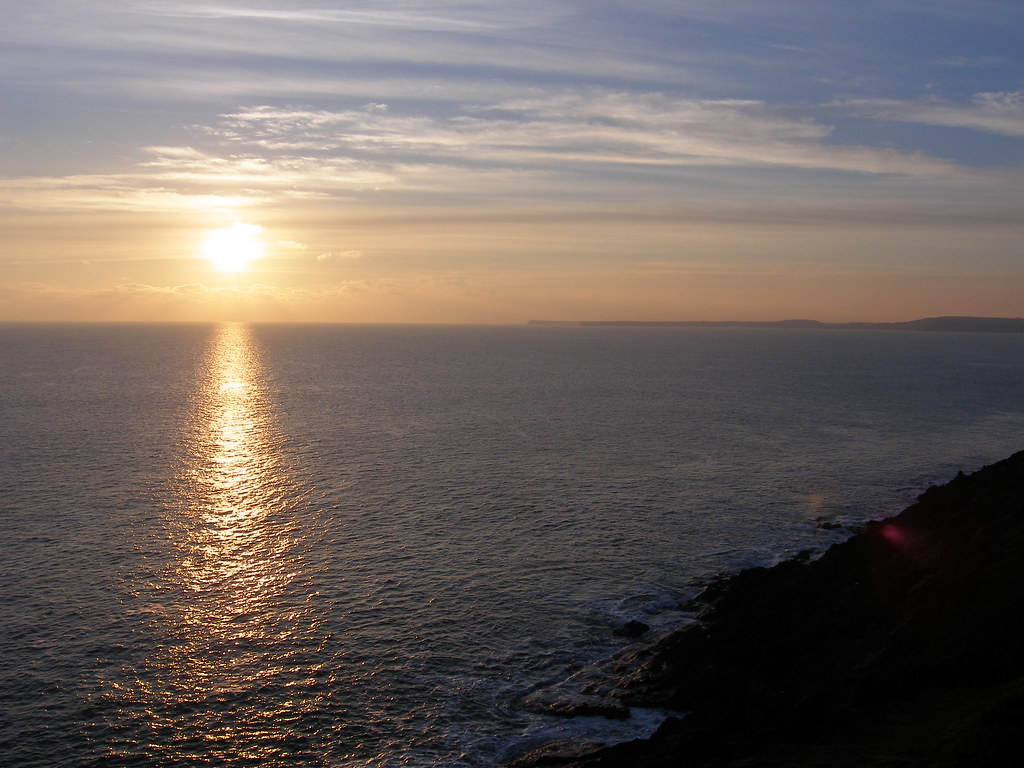
On a morning in early May, Bronwen Llewellyn walked a thirty-eight head flock of Hebridean sheep along a fenced corridor above the Pembrokeshire Coast Path, half a mile west of Stackpole Quay.
Llewellyn is the conservation grazier for the Stackpole Estate, a National Trust property that includes about twelve kilometres of coastal cliff and a series of inland heaths. She has held the role since January 2025.
The flock is small by commercial standards, which is the point. Hebridean sheep are a hardy, slow-growing primitive breed originally from the Scottish islands, prized in conservation work for their willingness to browse coarse vegetation that more productive breeds refuse.
What the flock is being asked to do is to keep down the spread of bracken, blackthorn scrub, and tor-grass on a series of cliff-top grassland blocks that have been gradually losing their characteristic short-sward heath flora since active grazing on the estate was reduced in the 1980s.
The vegetation of those blocks is significant. Pembrokeshire's coastal heath supports a distinctive flora that includes spring squill, sea campion, and several scarce lichens, along with a population of the chough, a red-billed corvid that feeds on invertebrates in close-cropped turf.
Without grazing, the heath converts within a generation to dense scrub, and the chough, the squill, and a number of less charismatic species lose their habitat. Mechanical mowing can substitute for grazing in flat areas. On a cliff, it cannot.
The flock's grazing plan is designed by an ecologist at the Pembrokeshire Coast National Park, with quarterly adjustments based on vegetation monitoring carried out by Llewellyn and a part-time botanist.
The current rotation moves the flock through nine paddocks of between two and seven hectares each. Each paddock is grazed for between one and three weeks at any one time, then rested for two to five months depending on the season and the target sward height.
Fencing is portable electric netting, set on fiberglass posts. The terrain makes installation laborious and Llewellyn has, on more than one occasion, fallen into the brambles while moving a corner post.
Hebrideans are good cliff sheep. They are sure-footed, agile, and small enough to handle ground that more substantial breeds would refuse. They will, when introduced to a new paddock, walk straight to the steepest edge and graze it first.
The flock loses about two ewes a year to falls, which is within the expected mortality range for cliff grazing in the region. Llewellyn keeps a log and the bodies are removed where access permits.
The vegetation response since the project began in early 2023 has been visible but modest. The April 2026 monitoring transects recorded an average sward height across the grazed paddocks of 4.6 centimeters, compared with 8.2 centimeters before grazing began and 22.4 centimeters in the ungrazed control block.
Spring squill density has increased by a factor of about three in the most heavily grazed blocks, and three lichen species that had not been recorded in the 2022 baseline survey have been observed in 2025 and 2026.
The chough population on the estate, monitored separately by the Royal Society for the Protection of Birds, has not yet shown a measurable response. Choughs respond to habitat improvement on longer timescales than vegetation does, and the estate's six breeding pairs in 2025 are consistent with the multi-year average.
The project is funded through a combination of National Trust core funds, a Welsh Government sustainable management scheme, and modest income from the sale of cull lambs. The economics are not commercially viable in isolation. The flock costs more to maintain than it returns.
Llewellyn does not present this as a problem. The flock is doing work that would otherwise cost the estate considerably more to do badly, and the lambs are a by-product of a vegetation-management exercise.
She is thirty-three, trained at Aberystwyth, and grew up on a hill farm in the Black Mountains. She is one of perhaps a dozen conservation graziers working full-time in Wales.
Asked what she expects the cliffs to look like in ten years, she said she does not know, and that the answer depends partly on the climate, partly on the politics of agricultural funding, and partly on whether the flock continues to do what the flock currently does.
She locked the gate behind the flock, checked the fencing, and walked back along the path toward the estate office with a coil of polywire over one shoulder.
The next paddock move is scheduled for the morning of June 11. The cliffs, in the meantime, will keep doing what the cliffs do, which is to weather and to hold what flora the grazing allows them to hold.